Posted by Matthew Boedy
On This Day in Rotten History...
In the year 904 – (1,113 years ago) — the Byzantine city of Thessalonica in Greece was sacked by an army of Arab Saracen invaders. The Saracens had departed from Syria with the original intention of taking Constantinople, but they’d been repelled by that city’s defenders. So they took a spontaneous detour to Thessalonica, where they found a city totally unprepared for their onslaught. Not only were the crumbling city walls in urgent need of repair, but the city’s two army commanders, who could not communicate with each other, were issuing conflicting orders that threw the troops into disarray. After a brief siege, during which the combatants used catapaults to bombard each other with flying rocks, the Saracens essentially hurled themselves, through a rain of stones and arrows, over the walls and into the city. Once inside, they spent a week killing, burning, looting, and taking prisoners. They captured sixty Byzantine ships, released four thousand Muslims held captive in the city, and took more than twenty thousand Thessalonicans as captives, most of whom they would later sell into slavery.
In 1967 – (50 years ago) — 250 people were killed and more than 1,500 were injured when a 6.5-magnitude earthquake struck near the Caribbean coast of Venezuela. In one fashionable neighborhood in Caracas, people and cars were buried under tons of debris when a quartet of ritzy highrise apartment buildings shook and staggered on their foundations, pounded into each other, and then collapsed like stacks of pancakes. The earthquake caused more than $100 million worth of property damage in Caracas alone, and left more than eighty thousand people homeless across northern Venezuela.
Rotten History is written by Renaldo Migaldi
Posted by Matthew Boedy
Listen live from 9AM - 1:00PM Central on WNUR 89.3FM / stream at www.thisishell.com / subscribe to the podcast
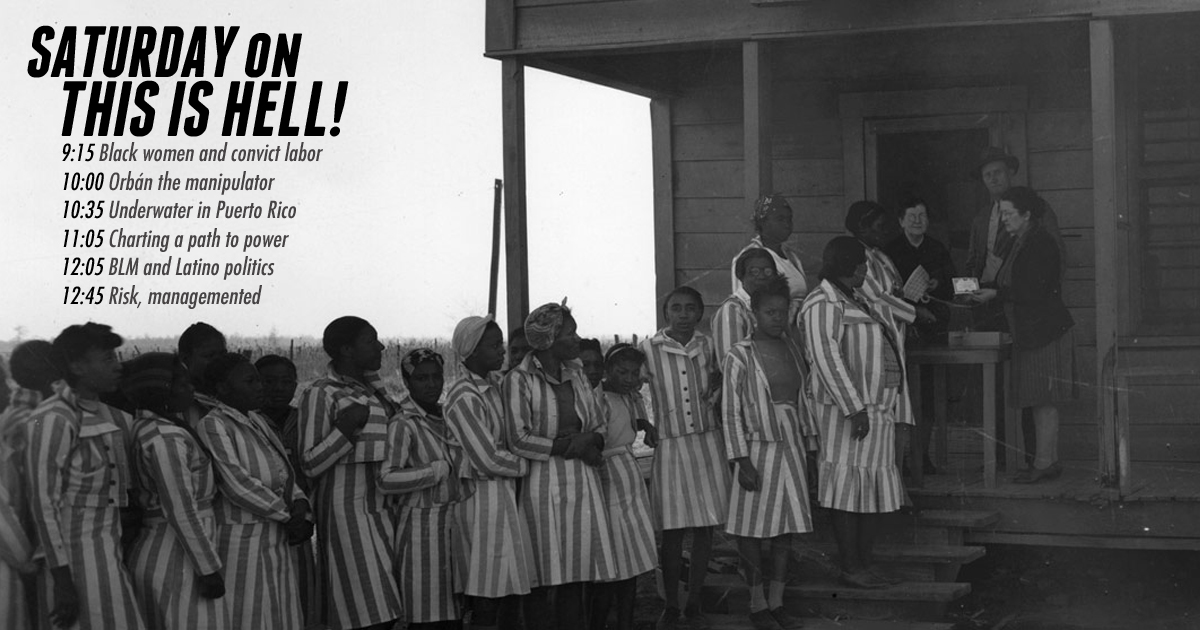
9:15 - Historian Talitha LeFlouria explains how the convict labor of Black women built the new South.
Talitha is author of the book Chained in Silence: Black Women and Convict Labor in the New South from UNC Press.
10:00 - Live from Budapest, Todd Williams reflects on Viktor Orbán's manipulation of Hungarian society.
Todd will also be talking about Soros, NGO influence, Hungary's upcoming elections and the World Swimming Championship. A busy time in Budapest.
10:35 - Our Man in San Juan, Dave Buchen reports on debt and dependence in Puerto Rico.
Dave is in town for next week's CLOSED CASKET: The Complete, Final And Absolutely Last Baudelaire In A Box at Theater Oobleck.
11:05 - Organizer Jane McAlevey charts out a course for claiming power in the Trump era.
Jane is author of No Shortcuts: Organizing for Power in the New Gilded Age from Oxford University Press.
12:05 - Historian Aaron Fountain explains how the Black Lives Matter movement is shaping Latino activism.
Aaron wrote the article How African American Activists are Influencing Latinos for Black Perspectives.
12:45 - In a Moment of Truth, Jeff Dorchen assesses the risk involved in risk avoidance.
Posted by Matthew Boedy
On This Day in Rotten History...
In 1916 – (101 years ago) — in San Francisco, business leaders and the local chamber of commerce sponsored a “Preparedness Day parade” to cheer the entry of US troops into World War I. Labor leaders, radicals, and anarchists who opposed US participation in the faraway European war planned to protest the parade, and had been warned of possible mischief by provocateurs. Shortly after the parade got underway, a pipe bomb exploded in the middle of the crowd, killing ten people and wounding forty. Two locally prominent left-wing labor leaders, Thomas Mooney and Warren Billings, were among those arrested by police, and were held for six days without being allowed to see a lawyer. In defiance of loud protests by labor and civil liberties activists, both men were soon found guilty — their death sentences later commuted to life imprisonment. More than twenty years later, a state commission found that their trial had been marred by false testimony and other irregularities, some of which were publicly admitted by the trial judge and jurors. Mooney and Billings were released from prison in 1939 and later pardoned. To this day, the real perpetrators of the San Francisco bombing remain unknown.
In 1962 – (55 years ago) — at Cape Canaveral, Florida, a rocket was launched carrying the spacecraft Mariner 1, intended to be the first to fly near the planet Venus. Soon after launch, the rocket veered off course and stopped responding to guidance commands sent from the ground. Fearful that it might come down and hit a populated area, mission controllers sent a command for the rocket to self-destruct, which it did. Analysts later found that a computer programmer who transcribed guidance software for the rocket had unwittingly introduced a typo, which science writer Arthur C. Clarke later called “the most expensive hyphen in history.” Five weeks later, a second launch sent the Mariner 2 spacecraft to a successful Venus flyby, where it measured hellish temperatures on that planet’s surface of nine hundred degrees Fahrenheit — hot enough to melt lead.
Posted by Matthew Boedy
Listen live from 9AM - 1:00PM Central on WNUR 89.3FM / stream at www.thisishell.com / subscribe to the podcast
9:15 - Behavioral scientist Samuel Bowles charts out the path towards a moral economics.
Samuel is author of The Moral Economy: Why Good Incentives Are No Substitute for Good Citizens from Yale University Press.
10:00 - Historian Elizabeth Catte explores the Appalachia-sized gap in the liberal worldview.
Elizabeth wrote the piece Liberal shaming of Appalachia: Inside the media elite’s obsession with the “hillbilly problem” for Salon.
10:35 - Columnist Adele Stan examines the dark money fortunes of the Trump White House.
Adele wrote the article What We Do Is Secret: Trumpism as a private-capital scam for The Baffler.
11:05 - Middle East scholar Wendy Pearlman talks about why it's so hard to talk about Syria.
Wendy returns to discuss her interview earlier this month, and her book We Crossed a Bridge and It Trembled: Voices from Syria.
11:35 - Investigative journalist Greg Palast digs through the GOP's vote suppression files.
Greg's latest report is Sanders and Jackson join hands to take on Trump’s Vote Thief-in-Chief at his website.
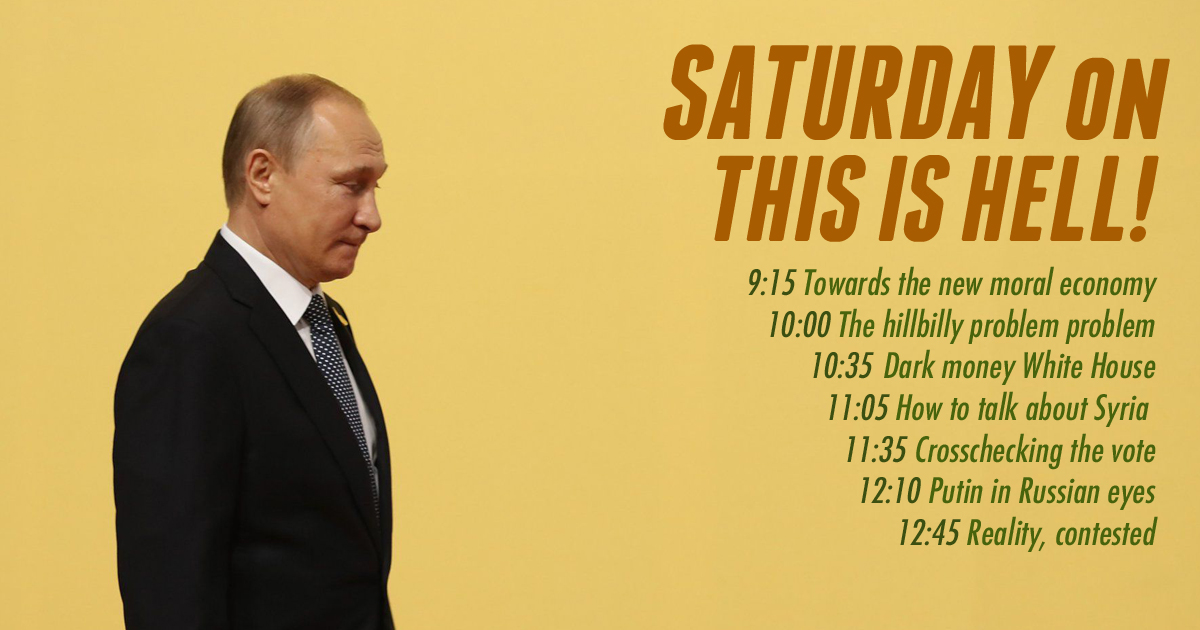
12:10 - Historian Sean Guillory looks at Vladimir Putin's politics, from Russian eyes.
Sean produces the very valuable and recommended Seans' Russia Blog podcast.
12:45 - In a Moment of Truth, Jeff Dorchen gives reality a strip search and pat down.
Is that the order you do those two things?